"Black Orpheus" - Marcel Camus, 1959
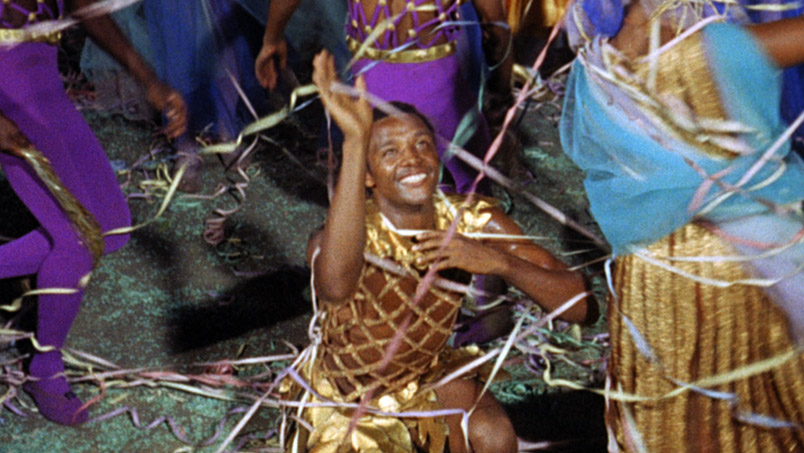
Black Orpheus is a very unique aesthetic experience. It won the Palme d'Or on the back of its daring combination of Greek tragedy and the upbeat sound of Brazilian bossa nova and other musics played in the background of the exuberant Caranaval. It remains a treat for eyes and ears, but many minds might find politics to take issue with here.
The film takes place on the rim of Rio de Janeiro. The bulk of the action of the film takes place around the homes of the main characters, all of whom live in favelas. The simplistic, cartoonish presentation of the Brazilian poor as very happy, content, "native" people having no qualms being geographically separated from the ruling classes is obviously problematic, but it exists as one module of a multi-layered film that might still have something to offer more discerning contemporary audiences. Black Orpheus can be split into three major sequences: the arrival and acclimation of Eurydice, the preparation and execution of Carnaval, and the descent into Hell to retrieve Eurydice.
The Arrival and Acclimation of Eurydice
The film opens with the beautiful Eurydice arriving in Rio, a place marked by vibrancy and musical spectacle. We learn soon that she has come here to escape a specter of Death that arrived near her home. She will stay with her cousin Serafina, but not before she is introduced to a few locals, the most striking of whom is Orpheus, who drives a cab. Orpheus is unenthusiastically engaged to Mira, who will soon learn from a marriage licensor that Orpheus, as the old story goes, loves Eurydice. Eurydice meanwhile is accepted at the favela by a crowd of gleeful children, one of whom bestows upon her a talisman. After a rough introduction, Orpheus and Eurydice look out to the horizon together and feel sparks of affection beginning to stir.
So far, we have a film that is openly centered on music and visuals, disclaiming a lot of the baggage that poverty should bring with it. Because of this thematic admission of a substitution of style over accuracy, I personally believe that Black Orpheus is able to overcome the problematic nature of its exposition, though Barack Obama disagrees, and that viewpoint is one to be taken very seriously.
The Preparation and Execution of Carnaval
One of the big claims to fame of Black Orpheus is exciting the European world to the prospect of Rio culture, the centerpiece of which in this film is Carnaval (essentially Mardi Gras). The visuals and music in this section are again obviously stunning, with gorgeous purples and golds everywhere. In this act, Eurydice is introduced along with the viewer to what Carnaval is, and she is caught up in the celebration and a newfound romance with Orpheus, who will be caught between her and Mira for the majority of this act. At rehearsal, Death arrives, scaring Eurydice and forcing Orpheus to take action to defend her. Death relents and allows Eurydice more time. That night, Serafina's sailor fling arrives in her home, prompting an invitation for Eurydice to stay with Orpheus. They eventually consummate their relationship.
The next morning, Carnaval begins. Serafina, wishing to spend time with her boyfriend, has Eurydice dress in her veil and take her place in the festivities. When Mira discovers the impostor, she is furious, prompting Eurydice to again flee a scene of mirth in mortal danger. Add to that the presence of Death at the festival, and a new pursuit begins. This time, as Orpheus corners the two in a trolley station, he turns on the power, causing Eurydice to be electrocuted and killed.
This sequence puts a lot of emphasis on the musical and visual elements of the film. The palette and rhythmic cinematography produce sheer delight, especially when coupled with musical elements that do not fade away. There is always some ecstatic drumbeat showered into the background of the mix until the final confrontation with Death occurs, at which point the music subsides for the appropriately hellish third act.
The Descent Into Hell
Orpheus is convinced that Eurydice is simply missing, despite discussion on the contrary from Hermes and others indicating that she is actually deceased. In the hall of records, he encounters a janitor who offers some critique of the machinations of man when he says that the only time the people go missing is when paper is trusted to keep their memory alive in the vain hope of recovering their physical bodies. The janitor leads Orpheus, as in the myth, on an altogether more spiritual search, taking him down a winding staircase into the film's equivalent of Hades. A dog named Cerberus guards a gate to a chapel wherein a ritual is occurring. Orpheus is told to call to his beloved, and music once again enters the film. As Eurydice is resurrected in the body of the old woman behind Orpheus, so too is the score of the film returned to the viewer. Unfortunately for Orpheus, this is short-lived, as he looks back at the old woman, causing the spirit to flee permanently.
The final moments of the film show Orpheus collecting Eurydice's body from the morgue and carrying it to the hill on top of which he lives, singing all the way. When he arrives to find his home burning and Mira fuming, he attempts to retreat, but a rock lobbed at just the right angle sends him falling over a cliff, concluding the tragedy of Orpheus. Three children sing songs with his guitar to help the sun rise and dance across a hill to close the film.
This is the part most heavily associated with Greek myth, with consistent references back to Greek names and an archetypal journey to the underworld the likes of which is rarely presented so clearly, and certainly not as often as the tropes established by stories like Orpheus that center on love. This part of the film offers a strong closing and a daring tonal shift that is deserving of plenty of plaudits.
Overall, Black Orpheus is a movie from a(n even) more naive period of history, and as such, has its fair share of problems. The experiences of individuals like Barack Obama with the film are not to be discounted, though, as I said previously, I would urge those who are incredibly critical of the film to take into account not only historical context but stylistic context. Recall that this is a musical, and musicals certainly have a tendency to become reductionist about the situations in which their characters live. Outside of these concerns, the film's real-world impact on opening Brazil to the European gaze with completely timeless audio-visual experiences is something it won't soon have taken from it.
★★★
Labels: ★★★
posted by tmichael @ 1:43 PM
0 Comments


0 Comments:
Post a Comment
Subscribe to Post Comments [Atom]
<< Home